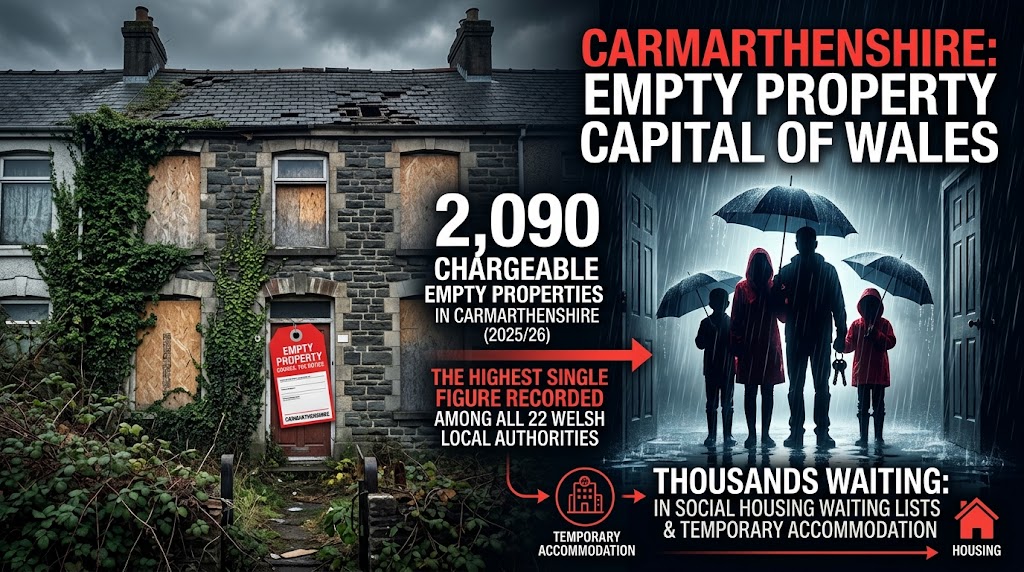
Every week while travelling across Sir Gaerfyrddin, the dual challenge facing our local housing market is clearly evident.
On one hand, local families, young workers, and vulnerable residents face extended waiting periods in temporary accommodation or struggle to secure suitable long-term housing. On the other hand, properties across our towns and villages sit vacant, deteriorating over extended periods.
Official data highlights that across Wales, over 22,500 chargeable residential properties have stood vacant for six months or more. In Carmarthenshire and across the region, bringing a proportion of these back into active use represents an urgent priority. It is estimated that between 3,600 and 4,500 vacant properties across Wales could potentially be transitioned into social housing stock through targeted support and policy reforms.
While developing new housing schemes requires significant lead times and capital funding, returning existing properties to occupation offers a swifter, cost-effective complement that supports the revival of local village and town centres.
Balancing Sustainability Standards with Immediate Housing Need
A key barrier currently limiting local authorities and registered social landlords from acquiring long-term empty properties is policy inflexibility regarding retrofit standards.
Under current guidance, newly acquired properties for social housing are expected to achieve high energy performance benchmarks, such as an Energy Performance Certificate (EPC) ‘A’ rating. While improving energy efficiency remains essential for lowering household bills and meeting climate targets, applying these maximum targets immediately to older housing stock significantly inflates initial acquisition costs. In practice, this often prevents local authorities from purchasing viable homes, including former council properties of identical construction to those already in active use.
A pragmatic, phased approach to energy efficiency improvements would allow housing providers to secure properties promptly while scheduling decarbonization retrofits over a realistic timeframe.
Key Issues & Scrutiny Priorities
Local Housing Supply: High concentrations of long-term vacant properties impact community vitality and reduce the housing options available to local families seeking temporary or permanent homes.
National Figures: Over 22,500 properties across Wales remain empty for more than six months, representing significant unrealized capacity within the existing housing stock.
Regulatory Alignment: Broadening flexibility around initial EPC acquisition targets would enable local authorities to bring existing properties into public housing stock more efficiently.
Program Continuity & Resources: Long-term sustainability for initiatives such as Leasing Scheme Wales and Houses into Homes is vital, alongside dedicated funding for local authority Empty Property Officers to process complex cases.
Key Scrutiny Proposals: Wales would benefit from a phased retrofit standard, centralized support for complex title/enforcement cases, effective utilization of Council Tax premium revenues, and strategic relief on Land Transaction Tax for social landlords acquiring vacant stock.
Constituent Feedback & Casework
If you are a constituent in Carmarthenshire impacted by local housing issues, or if you know of long-term vacant properties in your community that could be brought back into use, please share your details and feedback directly with my office.
Email: gareth.beer-as@senedd.cymru